Saturday, April 6, 2013

review: take me there

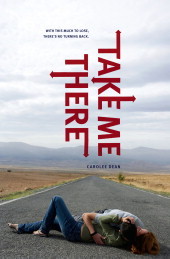
TAKE ME THERE Carolee Dean
Simon Pulse
I started Take Me There with high hopes. Despite the fact that the cover and back-page summary made it seem like an opposites-attract romance, it quickly became clear that this was really the story of a teenage boy determined to turn his life around -- and I liked that theme. Dylan Dawson Jr. is 17 and has already been in juvie, already been involved in a chop shop and associated with a gang. But now he's out of juvie, along with his best friend Wade, and he's determined to go straight. To not wander down the same path his dad -- who's on death row for killing a cop -- went down. But when the gang finds him again they make it difficult for him to stay on the straight and narrow and one night, through no fault of his own, he ends up on the run. From the gang member that's after him and the cops that are probably looking for him. He heads for Texas, where in less than a week his dad will be executed. Dylan has to know if the badness inside of him is something he was born with, something impossible to outrun, or if it's something that can be changed. He has to know the truth of why his dad is facing execution.

(Oh yeah, and also he can barely read. That's important too. Although he loves poetry and has memorized many of them (and even creates his own), actually reading is incredibly difficult for him.)

It's obvious from the first page of this book that Dylan is essentially a good guy. He wants to turn his life around and is doing everything he can to make sure that happens. His romance with the beautiful, rich Jess was alternately incredibly sweet and incredibly unrealistic. But despite what the summary would lead you to believe, his love for Jess is only part of Dylan's story -- more important is the road trip he takes with Wade to see his father again and get answers to his questions. The answers (and even the questions themselves) quickly become more complicated as Dylan realizes that the reason for his father's incarceration isn't nearly as cut-and-dry as he always thought. It's clear, too, that Dylan's dad is a good guy. He is repentant and trying in so many ways to right his wrongs. There are huge themes of repentance, forgiveness, mercy, and justice running through this novel.

Which is why the ending was such a colossal dissapointment. I don't want to give anything away, but I will say that up until the novel's conclusion I was for the most part enjoying this novel despite the few issues I had. (Most of my issues up until this point had to do with 1. the quick escalation of Dylan and Jess' relationship in a certain chapter, as well as how unrealistic much of their relationship felt on Jess' side, and 2. how heavy-handed the link between illiteracy and criminal activity often felt.) However, I felt that the book's ending was at odds with the story that came before it, taking the important themes that the book had explored so well and tossing them aside for a possibly-realistic, but definitely discouraging ending.

Thursday, April 4, 2013

the minimalist approach to books.

My family is in the midst of moving, so yesterday me and my mom were discussing minimalism. You know, get rid of all your belongings, one fork one plate one bowl sort of thing. And we were talking about what we could get rid of if we needed to -- could you get rid of your knickknacks? Your piles of notebooks? Old toys? Books? Gadgets? Basically: how much do we love this stuff? Because we shouldn't love any of it so much that we couldn't get rid of it if we needed to.

And I have a lot of books. They're all books I love, or at least really really like, and I'm glad I'm not in a position where I have to get rid of all of them, but I know that if I had to I'd be okay. My books are not the most important thing in my life.

But. Something else I think about sometimes: not getting rid of all my books, but the hypothetical situation of what if I could only keep a few? Five? Or ten? What if I had to fit my life into a suitcase or a couple of boxes? Which books would make the cut? Obviously there'd be my Bible, and a notebook. But I'm talking novels, memoirs, etc. You know.

So as of now, here's my list:


  1. Jellicoe Road, by Melina Marchetta - because it's such, such a personal story for me.
  2. Sweethearts, by Sara Zarr - again, so personal, and one i tend to reread fairly often.
  3. Anna and the French Kiss, by Stephanie Perkins - this one has plenty of my own notes in it and it's a sweet book that would obviously make whatever situation i'm in where i can only have ten books more bearable.
  4. serafina67, by Susie Day - favorite ever ya novel. i need my fictional personality doppleganger with me.
  5. The History of Love, by Nicole Krauss - just so incredibly beautiful.
  6. Gone With the Wind, by Margaret Mitchell - my favorite book.
  7. Bloomability, by Sharon Creech - another personal pick, and one that brings me back to my childhood.
  8. Walk Two Moons, by Sharon Creech - another brilliant book.
  9. To Kill A Mockingbird, by Harper Lee - i just love this one.


Alright, excellent counters will notice that there are only ten books on that list. My last spot is open. And honestly, making that list was harder than I thought. Not because I wanted to keep all of them, but because there were very few where I felt like oh, I need this book. And even though I've often been known to refer to my books as "my friends," and I do love having shelves full of my favorite books, I think it's a good thing I didn't have too hard of a time imagining getting rid of most of them.

But now I ask you -- ten books only: which ones would you keep? And would you be able to do it?

Tuesday, April 2, 2013

tuesday ten: fiction crushes

This week's topic from The Broke and the Bookish is "top ten fictional characters i'd have a crush on if i were also fictional." Alright, first of all this topic supposes that all fictional characters somehow live in the same universe. Which, okay, I guess I can go with that. FictionLand! Where all your favorite characters live and breathe.

Also, I'm keeping this limited to guys from books. And there's only eight. And yes, I know this post is late in going up.

1. Peeta Mellark
Hunger Games (series)
Suzanne Collins

2. Adam Kent
Shatter Me
Tahereh Mafi

3. Kurt Brodsky
Leverage
Joshua C. Cohen

4. Chris
Love and Other Perishable Items
Laura Buzo

5. Cole Archer
Mothership
Isla Neal & Martin Leicht

6. Xander Carrow
Matched (series)
Ally Condie

7. Alpha
The Disreputable History of Frankie Landau-Banks
E. Lockhart

8. Spencer Martin
Suite Scarlett (series)
Maureen Johnson

Friday, March 29, 2013

whose story is this, anyway?

In my long, unplanned hiatus from blogging, I started getting a ton of spam comments, so I've turned on comment moderation because this is out of control.

Anyway. I've begun editing one of my novels, the one told from two different first-person POVs, and this, along with reading the summary of Marie Lu's Prodigy, has me thinking about the nature of dual perspective novels. Specifically YA. Specifically the fact that many times books told from two different viewpoints are, really, just one character's story. Not that both characters don't have their own journeys, don't play different roles and offer different perspectives on events, but oftentimes after I've read the book and set it down, I feel like really it was Character A's story all along.

Across the Universe (series), by Beth Revis - Okay, this was obviously Amy's story all along. Maybe it's just because she's from earth so it's easier for the reader to identify with what she goes through, but as much as I liked Elder's chapters, his story and feelings were so completely wrapped around Amy and what she was going through that his story felt more like an extension of hers than something that belonged only to him. Whereas there were parts of Amy's story that had nothing to do with Elder.

Legend (series), by Marie Lu - Again, this is the girl's story, and I'm not quite sure why that is. Maybe it's because I naturally identify more with the girl in stories, so it seems like the story belongs to her instead of Day? Or maybe because June's worldview and scope is bigger than Day's in some ways -- she has more information about a lot of things, and it's her brother's death that is the catalyst for the series.

Love and Other Perishable Items, by Laura Buzo - This is Amelia's story. Partly because (if I remember correctly) her chapters are so much longer than Chris', and partly because it's her who sets up their relationship from the get-go: she's the relatable everygirl and he's the unattainable older guy (although of course both characters are much more complex than this, but in the beginning...)

Unwind, by Neal Shusterman - This is Connor's story and again, I think it comes down to the fact that while Risa and Lev are both a bit wild in their own ways and have very interesting backstories, Connor is the more relatable one. He's the one with the viewpoint and situation that it's easier (at least for me) to identify with.

I could go on.

But interestingly, there are a few books on my GR shelves that are truly split-POV, where the characters share the story equally. There are a few series (Peaches, Sisterhood of the Traveling Pants, and Luxe) of course, but there are also some great stand-alones where the two (or three, or four) characters share page time and story weight pretty equally.

Rival, by Sara Bennett Wealer - It's just about impossible to choose one character over another here, and part of the reason why is because Brooke and Kathryn's stories and backstories are so, so woven together. The story would fall apart if it was told solely from one perspective -- or at the very least it be a very different, much weaker tale.

Geek Charming, by Robin Palmer - This one I love because Dylan and Josh are such different characters. And I think that's part of what makes their dynamic and the book as a whole work so well. I was surprised when I started reading this, to discover it was told from both POVs, but it works really well. (And as an aside, the Disney Channel movie is so great, honestly. It's on Netflix, so you should give it a go.)

The Summer of Firsts and Lasts, by Terra Elan McVoy - Another one where telling the story from just one perspective would change it dramatically. These three sisters, though their stories don't overlap too terribly much, work so great as split-POV narrators; it really gives a fuller scope of the story, the characters, and the setting.

How to Save A Life, by Sara Zarr - I hesitate to say that this is split-POV done perfectly, but it's pretty darn near close.

So what are your favorite split-POV books, and does the story belong to all characters equally or is it really just one character's story?
Monday, March 18, 2013

some quotes.

I don't remember what I used to blog about, or I do but I can't think of anything new today even though I want to post something (I miss blogging), so here are other people's words from some novels.

Nothing goes away, Esteban says, after a long time passes. Not the things you remember, and not the things you still want.
-Small Damages, by Beth Kephart

I have already been torn to pieces
by you,
and pasted myself together again.
-Reunited, by Hillary Graham (Summer's journal)

What more could you ask of a person, Peter thought, than to risk all that they were for all they believed they could be?
-You Are Here, by Jennifer E. Smith

This particular story -- the Civil War, the best and worst of a whole country -- gave him a firm sense of hope that anything and everything could be repaired. Even the worst struggles could end in reunion.
-You Are Here, by Jennifer E. Smith

I do the right thing. I don't give up. I do it all with a smile on my face. I've always believed that I'm a good person.
What if I'm not.
-Reached, by Ally Condie (Xander)

We hold the choices of our fathers and mother in our hands and when we cling on or let them slip between our fingers, those choices become our own.
-Reached, by Ally Condie (Cassia)

Everyone can be fixed; it has to be that way, it's the only thing that makes sense.
-Before I Fall, by Lauren Oliver

Friday, February 1, 2013

review: out of the easy

OUT OF THE EASY
Ruta Sepetys
Philomel Books
(ARC received at ALA12)
There are some books that are objectively, almost undeniably very good. Ruta Sepetys' first novel, Between Shades of Grey was that kind of book. It was powerful and beautifully-written. But then there are other books that get away from the objective and on a personal level you just love them. For me, that's Sepetys' upcoming second novel, Out of the Easy. Set in 1950s New Orleans, this is a book that's more about a place, time, and atmosphere than it is around a historical event. Josie Moraine is a smart and good-natured girl stuck in a set of bad circumstances. Her mother's a prostitute who sees Josie as a burden (despite the fact that Josie hasn't actually lived with her mother since she was 11 and has instead kept her own apartment above the bookstore she works at); the owner of her bookstore is getting sicker and sicker; and Josie's chances of getting out of New Orleans and attending college are slim to say the least.

Josie herself is an awesome protagonist -- smart, sweet, down-on-her-luck, and entirely believable. Her story is helped by the cast of similarly lifelike characters around her, from the son of the bookstore owner to Willie, the madam who runs the brothel her mom works at. Despite the fact that Josie's ignored by her mother, she does have plenty of others who care about her -- it's just that her dreams and goals for her life don't quite match up with theirs.  Willie would be happy if Josie were her housemaid forever, but Josie longs to live in a place where everyone doesn't think of her as trash. I'm wary to give too much of what happens away so I won't get into the details of the plot, but I will say that this is one of the finest, most interesting historical novels I've read. While Josie's a great character and her journey is plenty interesting, the heft of this book's strength lies in its setting and atmosphere. The seedy of New Orleans is wonderfully realized here -- dusty, desperate, and incredibly well-written. Historical fiction is often difficult for me to really get into, but this one was just great; it hit all the right notes. Out of the Easy hits shelves February 13th, 2013.

Wednesday, January 30, 2013

review: prodigy

PRODIGY
Marie Lu
Putnam Juvenile
(ARC received at ALA12)

Prodigy is the sequel to Legend, one of the best dystopian novels I've read in the last few years. In this middle book, June and Day have teamed up and are off to find the Patriots, who are eager to start a rebellion against the Republic and, in return for helping June and Day, give the two outlaws the task of assassinating the Elector Primo. But the old Elector has died and in his place is his son, Anden, who disagrees with many of the policies his father enacted. As June gets to know him, and his plan for their country, she finds it difficult to go through with her part in the assassination plot.

I'm going to be honest here and say that, compared to Legend, Prodigy was a disappointment to me. Though there's still the strong emotional connection to the characters and their deep love for their families, this gets a bit muddled as June and Day join up with the Patriots and get swept up in the upcoming rebellion. Their romance, which worked well for me in Legend, falls prey to a few overly-cliche YA tropes here: the quick declaration of love, sudden love triangles, and an emphasis on their romantic relationship and feelings for each other that detracted from the rest of the story. The more I read, the more convinced I was that June and Day don't really belong together and I wished the book had focused more on how the Republic and the Colonies came to be than the romantic entanglements of its leads. Which, coincidentally, brings me to another small issue I had: in Legend I seem to remember nobody really knew if the United States had been a real nation or not; here in Prodigy there are a few references to the United States as if everyone knows the history of the Republic and the Colonies. This confused me and I wound up feeling like we'd somehow skipped over a chunk of June and Day's learning as they discovered more about their history. I wanted this "mystery" of the USA to be explored a bit in Prodigy and instead what I got was a fairly action-driven story of secret alliances, betrayals, and a plot to kill the Elector Primo. It becomes clear that there is no good answer for June, Day, and their country. This is entirely my preference, but I didn't love that. While it makes perfect sense that both the Republic and the Colonies were messed up in different ways, the fact that every single character in this book was corrupt in varying degrees bothered me; I like having a good guy to cheer for, not just a "lesser evil," and neither June nor Day remained as principled or good as I remember them being in Legend. In particular June's evolving feelings toward Thomas bothered me.

I was eager to discover more about the world June and Day live in, and how our world became theirs, but Prodigy was mostly concerned with what was currently happening to them, and though the twist near the end was supremely well-executed (probably enough for me to pick up the third book in spite of my issues with this one), I still didn't love Prodigy. I'm sure this book will work well for others; for me it seemed to be mostly the fact that I was expecting a very different book than the one I got.