Showing posts with label dystopian. Show all posts

Wednesday, January 30, 2013

review: prodigy

PRODIGY
Marie Lu
Putnam Juvenile
(ARC received at ALA12)

Prodigy is the sequel to Legend, one of the best dystopian novels I've read in the last few years. In this middle book, June and Day have teamed up and are off to find the Patriots, who are eager to start a rebellion against the Republic and, in return for helping June and Day, give the two outlaws the task of assassinating the Elector Primo. But the old Elector has died and in his place is his son, Anden, who disagrees with many of the policies his father enacted. As June gets to know him, and his plan for their country, she finds it difficult to go through with her part in the assassination plot.

I'm going to be honest here and say that, compared to Legend, Prodigy was a disappointment to me. Though there's still the strong emotional connection to the characters and their deep love for their families, this gets a bit muddled as June and Day join up with the Patriots and get swept up in the upcoming rebellion. Their romance, which worked well for me in Legend, falls prey to a few overly-cliche YA tropes here: the quick declaration of love, sudden love triangles, and an emphasis on their romantic relationship and feelings for each other that detracted from the rest of the story. The more I read, the more convinced I was that June and Day don't really belong together and I wished the book had focused more on how the Republic and the Colonies came to be than the romantic entanglements of its leads. Which, coincidentally, brings me to another small issue I had: in Legend I seem to remember nobody really knew if the United States had been a real nation or not; here in Prodigy there are a few references to the United States as if everyone knows the history of the Republic and the Colonies. This confused me and I wound up feeling like we'd somehow skipped over a chunk of June and Day's learning as they discovered more about their history. I wanted this "mystery" of the USA to be explored a bit in Prodigy and instead what I got was a fairly action-driven story of secret alliances, betrayals, and a plot to kill the Elector Primo. It becomes clear that there is no good answer for June, Day, and their country. This is entirely my preference, but I didn't love that. While it makes perfect sense that both the Republic and the Colonies were messed up in different ways, the fact that every single character in this book was corrupt in varying degrees bothered me; I like having a good guy to cheer for, not just a "lesser evil," and neither June nor Day remained as principled or good as I remember them being in Legend. In particular June's evolving feelings toward Thomas bothered me.

I was eager to discover more about the world June and Day live in, and how our world became theirs, but Prodigy was mostly concerned with what was currently happening to them, and though the twist near the end was supremely well-executed (probably enough for me to pick up the third book in spite of my issues with this one), I still didn't love Prodigy. I'm sure this book will work well for others; for me it seemed to be mostly the fact that I was expecting a very different book than the one I got.

Monday, September 3, 2012

review: flawless ruins

FLAWLESS RUINS
Kieryn Nicolas
Echelon Press
(bought as ebook)
The world that Morgan Waters knows is perfect. She has a wonderful mother, great friends, and access to all the material possessions she could want. Girls train for illustrious careers while still having time to hang out with their friends. And when they turn 17, each girl has an Amora -- a special ceremony where they meet their Like. Their perfect, practically tailor-made mate. The Likes adore them and take care of the less-glamorous aspects of life: laundry, dirty houses, etc. They dote on the women and, as far as Morgan knows, this is the way it's always been: there are women and there are Likes.

But one night, accidentally out past curfew, Morgan meets another type altogether. Neil, who looks like a Like except for the fact that he's messier, louder, and not attached to any woman. He's a man. A boy. Something Morgan didn't realize even existed. And thus follows the typical story arc of Morgan digging deeper into the realities of her "perfect" society and discovering astonishing things -- pasts, motivations, and entire cities -- that she had no idea about.

This is such a weird book, guys. There are some obvious problems in building a society like this -- one made up entirely of women, one where a teenage girl has no idea that men even exist. And while the book explains away some of the inherent problems, if you think about it too deeply it still makes no sense. There's quite a bit of suspension of disbelief needed to make this world work, so I opted to just not think about the world itself and focus on Morgan and her story. Surprisingly, this book is told from both Morgan and Neil's perspectives -- but it's so obviously Morgan's story and while Neil's chapters didn't exactly feel superfluous, they also sort of felt like just biding time between Morgan's chapters.

This book didn't shatter expectations. It's not a masterpiece of dystopic or sci-fi work, but it is a surprisingly enjoyable read. Morgan's pretty shallow on the surface, but this quickly gives way to a very, very determined girl whose principles surprise even her. As she uncovers more startling secrets about her world and how it's run she also finds herself falling more and more for Neil, whose life isn't nearly as cushy and safe as hers (to say the least). The characters here aren't as complex or fully developed as I generally like, but the story itself is a bit lighter than expected as well. Despite the heaviness of the plot and this messed-up society, the writing keeps everything from getting too depressing mostly by the fact that there's rarely much doubt that Morgan will win out against the more nefarious forces in her city.

This is a light, but fully weird book with one of the more messed-up dystopians I've seen (or, you know, maybe just messed up in a different sort of way). It's not earth-shattering, but it is enjoyable enough.

Friday, January 27, 2012

Review: Shatter Me

SHATTER ME
Tahereh Mafi
Harper/HarperCollins
Juliette can kill people just by touching them. She's a menace to her crumbling society and for 264 days she's been locked away and hasn't touched anyone. And then she gets a cellmate, a guy named Adam who isn't afraid of her and looks incredibly familiar. Soon, Juliette discovers that the Reestablishment - the people ruining what's left of the world - have plans of their own, to use her as a weapon in their war. Struggling to keep what little humanity she has left, Juliette must find a way to resist the plans they have for her and find a way to escape and make her own choices.

There is so much I absolutely positively love about this book. The world these characters inhabit is bleak and unforgiving and just a little bit too real; the horror of the Reestablishment is terrifying and its leader, Warner, is despicable and disgusting. When this book goes bad, it goes all the way bad. And though it's more than a little uncomfortable, it makes the stakes of the story all the higher and ups the tension. But on the flipside of this is the fact that when it's good it's absolutely brilliantly bright and wonderful.

First and foremost, I absolutely love Juliette. Tahereh Mafi has written an original, unique, and thoroughly incredible character in Juliette, a girl whose strange power has caused so much misery for her and others. Her parents refused to help her and ultimately abandoned her; she's been locked away from society and deprived of any human interaction. More than this, she's a good-hearted person who wants to help others but only ends up hurting them... and she has no idea why. Juliette is a girl determined to keep her humanity in a world that insists she doesn't have any and her internal struggles are written so, so perfectly. Her romance with Adam became a love story I'm rooting for almost instantly and it's hard to pinpoint exactly why. This is definitely a case of YA insta-love, which I often dislike, but here it worked, and it worked incredibly well as Adam is the only person Juliette's ever known who treats her as a human being instead of a monster and the two have a connection that's impossible to deny. Juliette, who despite everything still believes in beauty and love and goodness, has found much of this in her relationship with Adam.

The writing in this book is wonderful. Though the constant metaphors and strike-outs will no doubt be a bit much for some readers, it suits Juliette's character and struggles perfectly. Mafi's writing is lyrical and beautiful, pages and pages and pages of absolutely stunning sentences, though I have a feeling that the polarizing effect of this book (everyone seems to either love it or hate it) is due to this writing. You'll either love it or hate it, and I love it. The writing in this book is amazing; I honestly can't say enough good things about it. Love, love, love.

And all of that being said, though for much of this book I loved it more than I could even comprehend, at some point in the second half of the story things took a turn. The feeling of the book changed. As more characters entered the story, along with new twists, some of the urgency and desperation that had been at the core of Juliette's story in the beginning, went away. It's hard to discuss what happens without spoiling the whole book, but I will say that it ended in a way I wasn't expecting, a way that, while I kind of liked it, didn't seem to fit with the rest of the book. Juliette's unique and strong personality seemed to get diluted in the mess of people and events that were so different from what had come before. Additionally, too many hormone-fueled scenes between her and Adam took the focus away from the more important parts of the story. While these scenes were well-written, they often felt inappropriate and gratuitous in the midst of everything else that was happening: it was as if Juliette's focus had shifted away from protecting herself and Adam and the larger issues she was grappling with earlier in the book and over to a complete preoccupation with sex. In a way this makes sense, considering that she hadn't touched anyone in nearly a year, but still it seemed like a lot of (fairly redundant) overkill that felt like way too much and also stalled the plot.


Still, despite my issues with the last quarter of this book, this is one story that completely captured my attention. It overwhelmed me with how beautifully it was written and how complex the characters are. The ending nicely sets up a second book and while I worry the feeling of this second book will be (judging by the ending) so different from what makes this first book incredible, I still love Shatter Me and am cautiously optimistic about book #2. There were so many huge passages from this book that were incredibly, searingly beautiful, and the character of Juliette has a place as one of the most original characters and a personal favorite of mine. Bottom line: I love this book. So much.

Friday, December 23, 2011

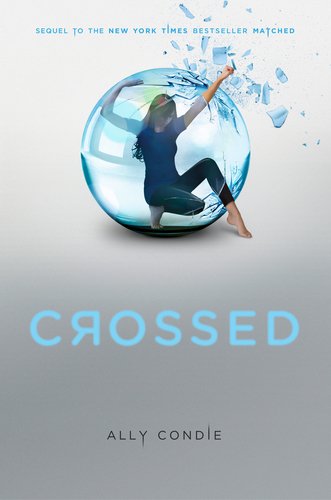
Review: Crossed

CROSSED
Ally Condie
Dutton Juvenile
Since this is a review of a sequel (Crossed), there may be slight spoilers for the first book in the series, Matched.


The second book in the Matched trilogy, Crossed is told from both Cassia and Ky's perspectives as Cassia, having left the Society, travels through the wilderness to search for Ky. Along the way she discovers more about the Society and those who rebel against it.

I loved Matched. Loved it. It wasn't the most action-packed dystopian novel, but it was beautifully-written with a kind and compassionate protagonist. I was looking forward to the continuation of Cassia's story, but I have to admit - Crossed was a disappointment. A large part of this, I suspect, is that half of the book is from Ky's POV and I just don't get him. I don't see the big deal. His personality mostly seems to be an extension of Cassia's. In the first book it was fine that there wasn't much to him because we got to view him through Cassia's love-colored glasses, but getting his first hand account slowed the book for me.

This book suffers from the worst type of middle-book syndrome in that there's a lot of set-up for the next book and plenty of things carried over from the first book, but just on its own there's not much there. Despite Cassia finding out about some fairly big revelations about the Society, Ky, and what lies ahead, it always felt like there was nothing happening. Cassia and Ky are, aside from a few travel companions, mostly cut off from other people - Cassia's family isn't part of this book and though Xander is still important to Cassia he's not much a part of the story this time around. And whereas in the first book the obsession with words and art was meaningful as it showed the choices that Cassia wanted but didn't currently have, here it slows the book even more as, apart from the Society, it was harder to see the poetry and art as forms of rebellion.

One of the things I loved so much about Cassia in Matched was her devotion and loyalty to her family. And while this is still a part of her character it's fairly unimportant here as her family isn't around. With all of her emotions and attention focused on finding Ky and on how much she loves him and how much she's willing to risk to be with him, she started to feel like a one-note character. If I liked Ky, of course I would probably feel differently about it.

This was an extremely slow read. Yet in spite of that I kept reading. Partly because I felt invested in the story after liking Matched so, so much, and partly because there are just enough seeds planted for the next book in the series that I didn't want to give up on it. Though Crossed was ultimately a disappointment I still have hope that the series, as a whole, won't be.

Wednesday, November 30, 2011

Review: Legend

LEGEND
Marie Lu
Putnam Juvenile
What was once the western part of the United States is now the Republic, ruled by the Elector Primo. The plague sweeps the nation every year, with the poorer citizens dying while the rich are able to afford vaccinations. Futures are decided by an exam (the Trial) taken at ten years old. Fifteen-year old June is a military prodigy and the only person to even get a perfect Trial score of 1500. Day failed his Trial and is now the Republic's most wanted criminal. When June's older brother - a high-ranking military official - is killed on the job, Day is the primary suspect and when June chases after him to avenge her brother's death, both of them discover more about their world than they bargained for.

June and Day, though they're the same in many ways, lead wildly different lives and have entirely different perspectives on the Republic and the book's split-POV narration portrays this so well. Because of getting both perspectives there's a big difference between what the reader knows and what the main characters know; this makes the story even more tense, which is definitely a good thing as certain big plot points in the book are fairly easy to predict, which means that a lot of the story's strength has to lie in other aspects: the characters, pacing, setting, and stakes.

It's often difficult for me to become emotionally invested in a dystopian novel - with the notable exception of The Hunger Games trilogy, not many in the genre have been able to tug at my heart. This book is the exception. The love between June and her older brother, as well as her profound sadness at losing him and her need to bring justice, is not only seen but felt. At one point early on I almost thought I'd have to quit reading because her emotions were so sharp and the story so sad. The fact that Day's story was just as touching only made the tension between them, between his wants and hers, even stronger.

As far as plot goes, though the smaller plots flowed great, with pacing that added plenty of tension, the larger plot points, mostly involving the nefarious activities of the Republic, were easy to predict. While this was a definite problem in the book, the slow world-building and questions about how the Republic came to be ultimately overwhelms the predictability. With characters that are easy to connect to (not only Day and June), true emotional content, and high stakes, this is a book I'd definitely recommend.

Monday, August 29, 2011

Review: Divergent

DIVERGENT
Veronica Roth
HarperCollins Childrens Books
In a future-world Chicago, the city is closed off from the rest of the world and divided into five factions, each one honoring the quality they feel is the best way to live. Beatrice (Tris) Prior was born into Abegnation (the selfless), but at 16, after taking the aptitude test, she must choose for herself which faction to live by. Choosing anything other than Abegnation will mean leaving her family forever, but after years of trying she still isn't as selfless as she should be. So she chooses Dauntless (the brave), a faction that has always fascinated her, and soon realizes that life as a Dauntless is more difficult than she expected. She first has to survive initiation, a feat in itself, and survive well enough to avoid being cut from Dauntless and living among the factionless - society's outcasts.

I'm not usually very particular when it comes to world-building, but the society in Divergent didn't work for me. While I loved the idea of the different factions (Abegnation = selfless; Amity = peace; Erudite = intelligence/knowledge; Dauntless = bravery; Candor = honesty) I found it difficult to believe that so much of the population was easily sorted into one particular faction or that it would be so easy to be defined solely by one quality. This world was extreme; there was no balance. Being brave doesn't mean you can't also be honest, selfless, intelligent, or even peaceful. These qualities are not at odds with each other yet here, they are. When Tris' aptitude tests come back inconclusive and she's labeled "divergent" (meaning she fits into more than one faction), I was amazed that being Divergent was so rare. It was hard for me to get past the extreme views put forth by the characters of Divergent.


Tris, who has been raised in the selfless faction of Abegnation, chooses to be brave and leave her family. She says it's because she's never been selfless enough for Abegnation, and this is true: she's not selfless. In fact, at times I found it startling how selfish Tris was, especially during her initiation into the new faction. Dauntless is a faction that appreciates an extreme, often dangerously stupid sort of bravery. There are no rails on hallways towering high above the ground and the initiates must fight each other until one is unconscious and one is the victor. It felt senseless, like violence for the sake of violence, and Tris slipped into the role of cruel Dauntless initiate a bit too easily. While I liked many of her new friends (especially Christina, who came from the faction of Candor - honesty), Tris herself was difficult for me to root for and I suspect this may have been partly because I find it so difficult to relate to her. The selfless faction might not be the first I would choose, but the faction that leaps onto and off of moving trains would definitely be last on my list. However, as the book goes on, Tris grows as a character. In an ironic twist, choosing to be brave ultimately teaches her how to be selfless and by the end I could easily see why so many readers love her.

The story of Divergent hinges on the different factions, however the majority of the book is taken up by Dauntless initiation -- it's exciting, but I often wondered what it was building to and since I didn't particularly care for Tris, it was difficult to stay engaged in the book. The real story doesn't take off until the last 80 or so pages (the last fifth of the book). This is a lot of build up, yes, but for many readers it will be worth it not only because those last 80 pages are so intense, but also because the build up is also so full of action and adventure. For me though, it ultimately fell flat. It took too long for me to really care for Tris and even when I did I wasn't sure I liked her. The romance with Four wasn't as captivating as I wanted it to be and though there were some seriously great moments with Tris' friends, it wasn't enough. I wanted more from this book - or maybe just different - than what I got. I wanted to really understand why everyone in this world finds it so easy to take on one personality trait above all others and why Divergence was so rare. I wanted to be 100% behind Tris, but I never truly agreed with the choices she made. I wanted to connect with this book, but I couldn't. As much as I love the idea of the factions, the story itself wasn't nearly as captivating as the idea of it.

Friday, April 1, 2011

Review - Wither

WITHER: THE CHEMICAL GARDEN TRILOGY
Lauren DeStefano
Simon & Schuster Children's Publishing
Set in a nearby future where, due to genetic experimentation, males only live to age 25 and girls to 20, young children are routinely orphaned, extreme poverty is everywhere, and the threat of a young girl being kidnapped and sold into a polygamous marriage to those few wealthy men is common, Rhine is one such child bride. At the age of 16 she finds herself married to Linden, a frail and willowy 21 year old whose first wife and true love is quickly dying at the age of 20. Along with her two sister wives, Jenna (age 18) and Cecily (13), Rhine is expected to take the place of Linden's first wife.

This is unlike other books marketed as dystopian that I've read. While there is a worldwide issue, the story is much more focused on Rhine being forced into a polygamous marriage than it is the crisis of everyone dying so young. As this is the first in a planned trilogy, it's entirely possible that the short lifetime will become a bigger issue in the next two books.

Rhine is a wonderful character with a surprisingly fleshed-out history that really added to the understanding of who she is and the decisions she makes. Likewise I loved her two sister wives and the relationships she had with each of them. While Jenna is beautiful but stubborn and hates their husband, young Cecily is ecstatic about her rich new life and eager to fit into her new role. Each of these characters (as well as their husband, Linden) changed throughout the course of the novel and I loved reading about them. To be honest there was a part of me that wished this story had been told through each girls' perspective just because I liked Jenna and Cecily so much.

Unfortunately, while I loved Rhine's relationships with her sister wives, the relationship she had with Linden came across a little lukewarm to me. Her feelings towards him often seem a bit wishy-washy and she seemed oblivious to a few key things that seemed fairly obvious to me. I felt that her fond feelings for him were a part of the story just to provide something of a love triangle between Linden, Rhine, and Gabriel (the servant boy she falls for) and this didn't ring true to me. Although as an aside, this may be due in part to the fact that I thought the slow development of Rhine and Gabriel's feelings was incredible and I really loved him as a character.

Aside from the characters and their relationships, the plot here is one that definitely kept me on my toes. There's a genuine darkness and sense of dread to this book, which is as much a mystery as it is dystopian, and I found it difficult not to skip ahead to the last page (don't worry, I didn't!) to find out how it ends. The ending, while offering hope, seemed almost too easy and didn't bring a real satisfaction to the rest of the story. While this is the first in a trilogy and I'm sure the various mysteries will be unraveled in the next two books, I am of the opinion that a first book should be able to stand on its own and unfortunately I don't think this one does.

*Received ARC at ALA.

Friday, January 7, 2011

Review: Across the Universe

ACROSS THE UNIVERSE
Beth Revis
I've had this book sitting on my shelf for months, waiting for the new year to read it. This is the first YA sci-fi I've found and it takes place on, as the cover says, a "spaceship fueled by lies." Amy is a teenage Earth girl who was cryogenically frozen 250 years ago - before the ship took off for it's 300 year journey to a new planet. Elder is the teenage heir to the ship's tyrannical current leader, Eldest. Together, Amy and Elder must not only keep Amy safe aboard a ship where she's labeled as a "freak," but also figure out who keeps unplugging the cyro chambers, killing the people inside of them.

The premise here - murder and lies aboard a spaceship - is fantastic like woah. However, despite the description on the back cover of this book there are lots of little subplots inside that sometimes distract from the main story. Elder's interest in his biological parents is a subplot that doesn't really come in until the very end of the novel and other storylines, such as Harley's story and the character of Luthe, felt either out-of-place or like they should have been bigger than they were. The murder mystery aspect gets forgotten for a time, so much that when it came back into the story I'd almost forgotten about it. However, despite the many storylines the ship's mysteries are incredibly interesting and make this sometimes-slow-moving book a page-turner.

While a few of the characters seemed a little one-dimensional, for the most part they were awesome and realistic as they dealt with life on the ship. The two lead charcters, Amy and Elder, were especially awesome - Amy as she navigated her way through a world where everyone just seems a little bit off and tries to make peace with having to live with these people for the rest of her life, and Elder as he tries to protect Amy and find out what secrets Eldest is hiding from him. Probably the biggest issue I had with these characters was the fact that after a while Amy and Elder's voices (the book is told from their alternate POVs) started to sound very similar and I sometimes had to double-check whose chapter I was reading.

I can't review this book without talking about the setting. OH MY GOODNESS THE SETTING. There is a whole world on board the spaceship called Godspeed, and though it's very obviously a dystopian society it didn't remind me at all of other dystopian books I've read. Here, everything is the same. There is one race, no religion, and most everyone on the ship seems incredibly empty-headed, incapable of believing anything different from what Eldest tells them to believe. The exception here are the "crazy" people in the Ward, including Elder and Harley, who almost seem like real people. The outlooks on art, sex, and individual thought is bizarre to say the very least. 

This book was different from what I was expecting. There were more mysteries, more intrigue, and less romance than I was expecting. And though I didn't totally love it, I did like it quite a lot and now I find that I can't stop thinking about it. Across the Universe is one of those books that I want to like more than I do, that's different from what I expected, and that I'm eager for the sequel to. Yeah, all of that.

*Across the Universe comes out Jan. 11

Tuesday, January 4, 2011

Review: Matched

MATCHED
Ally Condie
In Cassia's Society, people are told where to live, where to work, when to die, and who to marry. The system is perfect, of course: each person who chooses to is Matched with their perfect Match. And on her seventeenth birthday, Cassia is, too. Unlike other girls, whose Matches live in other cities, hers lives just down the street. Hers is her best friend, Xander. But then something happens: the screen flickers and, just for an instant, its another boy's face staring back at Cassia. This boy is not her best friend, not her Match - he's someone she never should have been Matched with. And yet she was, for just an instant, and this paired with the secret poems her grandfather gave her at his Final Banquet before he died, changes everything for Cassia. For the first time in her life she sees choice. She sees that there is more to living than what the Society tells her there is.

This was an amazing, slowly-building, page-turner of a book that was incredible in so many ways. I don't even know where to begin. One of the most astounding things about this book is that in the beginning it really isn't that good. The writing is clunky and the characters seem flat. But then, as Cassia develops as a character her voice develops as well until it is filled with a type of impossible-to-describe poetry. As brilliant as the premise is, its the combination of all the elements that really make this book fantastic. The plot, through slow-moving, is exceptionally crafted. There's a sense of something more lurking just below the surface and despite its lack of action, this book manages to be nearly unputdownable. Though the Society Cassia lives in is said to be peaceful there's a constant threat of danger just under the surface, a threat of Cassia losing everything she loves if it's discovered that she's read poems she shouldn't and is falling for a boy who isn't her Match.

Surprisingly, despite being less developed than other parts of the novel, it's the characters that really made this story for me. Cassia herself is absolutely wonderful as she dares to step out of the box and push the envelope of what's expected and demanded of her. The journey she takes from the first page to the last is an overwhelming one with a few unexpected turns, but she has a kind of quiet, inner strength that you don't often find in the protagonists of dystopian or sci-fi, who are typically more kick-ass than kind and loving. But Cassia - and those around her - is loving. She cares deeply about not only her family, but also Xander and Ky (the boy she wasn't supposed to be Matched with). She breaks the rules, yes, but there's a limit to what she's willing to risk. Like Cassia, the other characters around her are also quiet risk-takers. From Ky, who gets by on being absolutely average and knows how to write by hand to Xander, who's willing to hide forbidden items for Cassia and bend the rules for their friends, to Cassia's parents and grandfather who each rebel in their own small way to protect the ones they love. However, despite all these things I wanted more from these characters and their relationships. Though Cassia is incredible and amazing and I want to be friends with her omg, other characters are less developed. I was surprised at how much of the time Xander wasn't in the book, as well as how ambivalent I felt towards Ky.

Despite having a premise that revolves around a love triangle, I just didn't feel it. There was no love triangle, really, not for Cassia. It's not about her choosing between Xander and Ky; it's about her fighting to be able to choose at all. And while this is absolutely wonderful and the feelings between her and Ky are undeniable and well-written, the character of Ky himself wasn't very impressive. I felt that while Xander can stand on his own what makes Ky really interesting was the mere fact that Cassia found him interesting and that there was this love between them that seemed to transform things.

To put it simply: I love this book and can't wait for the rest of the trilogy. It's amazing, incredible, unexpected, etc. It's rare to find a dystopian novel as emotion- and character-driven as this one, and it works perfectly.

Saturday, December 25, 2010

FIVE: Most Anticipated 2011 Titles

1. Delirium
Lauren Oliver
I've just heard awesome things about this and the premise of it is wonderful. I haven't read a ton of dystopian novels, but a lot of them -- especially this one -- are really sounding great lately.

2. Where She Went
Gayle Forman
I'm not typically a big fan of sequels, but I absolutely adored If I Stay, and the whole idea of this book being from Adam's POV is amazing. Can. Not. Wait.

3. Invincible Summer
Hannah Moskowitz
Moskowitz's first novel was incredibly different from a lot of what I read, but I really loved it and I'm excited for this one. I'm such a fan of YA novels about family and Break handled the subject so well.

4. What Happened to Goodbye
Sarah Dessen
Sarah Dessen. Need I say more?

5. Imaginary Girls
Nova Ren Suma
In addition to having one of the best titles and most beautiful covers I've seen in... well, ever, probably, it's also a story about sisters which I love. I really liked Suma's middle grade novel and I'm really excited for her YA debut.

Thursday, December 23, 2010

FIVE: Series on My List

I'm not a big fan of series. Either I don't read them because I really honestly like stand-alones better, or I feel like if I buy the first I have to buy the others and I'd rather not make the commitment. I don't think I've read five different series this year, so instead of listing the five best I'm going to list five series I want to read/finish.

1. Matched
Ally Condie

2. Summer
Jenny Han

3. Delirium
Lauren Oliver

4. Confessions of Georgia Nicholson
Louise Rennison

5. Gallagher Girls
Ally Carter

Some of these are series I've already started reading but there are more books out than I've read, and others are ones I haven't even started yet but really really want to.

Saturday, December 11, 2010

Best YA Couple of 2010

Alexa, over at Not Enough Bookshelves, is doing a countdown of the best couples in YA for 2010 and I thought I'd share my favorites. For her, it's a countdown to Christmas and for me it's just one Best-of-the-Year/End-of-the-Year post.

I thought I'd have a bunch of couples to choose from, but looking at my Goodreads shelves and the reviews I've written... there really aren't many romance stories on there. Sure, I read a few, but the ones I really loved weren't focused on romance and the most realistic, incredible characters had dynamic stories that don't fall under the category of romance. For the most part the best couples weren't even couples. Or they were, but not until the very end. Or they weren't, but I thought maybe sometime in the future they would be. Yes, I know this is fiction.

So with all of that said, the best YA couple of 2010? (Warning: spoilers for a certain book/series after the jump.)

Wednesday, September 15, 2010

Review: Mockingjay (spoiler free!)


MOCKINGJAY
Suzanne Collins

Looking at MOCKINGJAY objectively is going to be nearly impossible. For me, for you, for anyone, I think, if only because it's such an emotional novel. Love it or hate it, there's no way to get through these four hundred pages unscathed, without having some sort of extreme emotional reaction. Some have said this book broke their brain. Others describe it as the Mockingjay hangover or Post-Traumatic-Mockingjay-Disorder.

Yes. I am writing this the day after finishing the book and I agree with the above. It broke my brain. I'm in a post-Mockingjay haze and attempting to write a review. So please, bear with me.

First, as if the extraordinarily high score above wasn't clue enough, you should know that I love this book. I think it's brilliant, I think it ended the trilogy perfectly, and in fact I think it was the best of the bunch. I love it so much that a mere 10 of 10 seems like a low score. Honestly, I wish I could break the rules of math and give it a 12 on the "fangirly" scale.

Of course the premise and plot are continuations of the first two books in the series, but this time things are different. Katniss Everdeen, after breaking the force field surrounding her second Hunger Games, has been rescued by District 13. While Peeta Mellark is captured by the Capitol, the rebels are asking Katniss to become the Mockingjay -- the symbol, the face, of the revolution. Agreeing to this means working for District 13's president, who isn't exactly the biggest fan of Katniss, but it's also the only way she can save Peeta and the rest of the victors. And the only way she can kill President Snow. This book puts us in an entirely new setting -- not District 12, not the arena or the Capitol, but instead District 13, underground, and the various poor districts where the revolution is being fought. The atmosphere, mood, and setting is clearer than ever in this book. Between the ruins of Katniss' and Gale's home, the stark and strict District 13, and the fighting, every place we visit in this book is so incredibly intense. Full of emotion and desperation, I'm not sure I've come across a book that did a better job of showing setting.

In this book, Katniss really grows into herself. Unlike in the previous books, now she has some power (although maybe not so much as she'd like) and is much less unsure and wishy-washy than before. Yes, she still goes back and forth on some issues, but when she does her motivations and confusions are much clearer. There was, surprisingly, only one point during this book that I wanted to throw it across the room. And, in hindsight, I believe there was more at play in this moment than was clear in the scene itself. (Those of you who've read the book may know what I'm talking about.) Since this is the one book that doesn't feature the Hunger Games, we get to see Katniss with the people she grew up with. This means that her and Gale's relationship is pushed to the forefront, the relationships with her mother and Prim are revisted in more detail, and we really get to see the love she has for the place she grew up. Throughout THE HUNGER GAMES and CATCHING FIRE, Katniss was so incredibly independent that it was really hard to see the feelings she had for her family. She was often impatient with her mother and though she took her sister's place in the Games, we really didn't get to see much of this relationship. In this book, that was remedied. We get to know the sisters' relationship, as well as getting to know Prim as her own character. It was also nice getting to know Gale better. I'm not a Gale fan and always felt that his relationship with Katniss was closer to that of a brother or cousin than boyfriend, but that said, I loved really being able to see the history that the two of them had together before the Games.

As for Peeta and what happens to him in the last installment, there's not much I can say that isn't a spoiler. I will say that there is a new (and very painful) component to the Peeta/Katniss relationship. And yet, as painful and awful as it was, I think it played out perfectly, especially as we got deeper into the story. That said, this book is definitely not about Gale v. Peeta. Yes, that is an element, and one that Katniss struggles with. But it's not at the forefront. It shouldn't be at the forefront. Katniss, Gale, Peeta, and everyone else in this incredible book, are dealing with a war and the consequences of war. There's not a lot of time for teenage love here.

Throughout the entire series, I had some pretty big problems with Katniss. I wasn't sure I ever liked her. As compelling as she was, it wasn't her that made me want to continue the series after THE HUNGER GAMES. It was Peeta, it was the twists that happened along the day, it was her world that sucked me in. And while MOCKINGJAY still didn't make her my favorite character ever, it did an impressively good job of redeeming her in my eyes. In this book, she had emotions. She was conflicted, but it was understandable. On the whole, she wasn't cold, and when she was you could see why. With the exception of one scene, one heart-wrenching, what-the-hell-are-you-doing-Katniss!!!?? scene that boggled my mind, I liked Katniss. For the first time I felt like I understood her. (And that one scene? I think Collins leaves it up to us to figure out what we think was going through Katniss' mind at that point, and what I think was happening behind the scenes redeems her, if that makes any sense to you.)

This series ended perfectly. This book ended perfectly. Collins did the seemingly-impossible in that she wrote a real, true-to-the-story ending that only made me love the series more. She stayed true to what she'd set up previously and somehow made it work unbelievably well. Honestly, the ending might just be my favorite part of the entire series.

If you've read MOCKINGJAY, I'd love to discuss it with you!! Please keep comments spoiler-free, but feel free to email me!

Tuesday, September 14, 2010

Tween Tuesday: The Limit


THE LIMIT
Kristen Landon
In this middle grade dystopian novel, we meet Matt. A young, brilliant math geek whose not-so-brilliant parents have gone over their "limit" -- the government-imposed debt limit. What this means for Matt is that he's sent away to a workhouse to help pay off the debt until his family gets back under the limit. What he's expecting to be a child slave camp is actually pretty cushy; he tests into the Top Floor, which is reserved for the smartest kids who do the most difficult work, and suddenly he has everything he could want. New clothes and gadgets are just a click away and he's free to spend most of his time playing sports or video games with his fellow Top Floors. But, as with every dystopia, all is not as it seems. Children on the other floors are having massive headaches, sometimes even seizures, and when his own sister ends up suffering a seizure when she arrives at the workhouse, he becomes convinced that something bad is going on around him. This, along with the fact that he's forbidden to leave the top floor or go outside, pushes Matt to risk everything to discover what's really happening in the workhouse.

This was an enjoyable and interesting book, however I did have some issues with it. The main problem I had was that it took a long time to really get going -- it was well past the 50 page mark before I felt like I had to finish it. Page 137 to be exact, which is nearly halfway through the book. There's a lot of set up here that I doubt many kids would sit through (just like I almost didn't). The characters are likable however, as with much else in this book, it took a long time to get to know them. For much of the book I wasn't sure who, aside from Matt, the main characters really were, and though the relationships are believable and well written, I did feel a lack of connection since everything exciting happened so late in the book. To be honest, pacing was an issue throughout (which knocked major points off of what was an otherwise very interesting and captivating plot), with the first half of the book nearly at a stand-still and the ending coming very quickly, skipping a few scenes I would have loved to see, and going right into what read like an epilogue.

There's a clear message of delayed gratification and living within your means here, although it seemed out of place since that wasn't quite the evil badness that these Matt and his friends were up against. Also, as much as I believe that life lessons can be woven into books well, this one seemed a bit heavy-handed in its message that seemed more fit for teenagers and adults than children in the first place -- though I could be wrong on that. Still, as unsure as I was of the message, the plot of this book had me hooked once it finally got going, and I admit that I read a few pages during school when I really should have been paying attention to class instead. In the end, despite the pacing problems it had, I'm so glad I read this book because I really did enjoy it, and while I wouldn't recommend it for reluctant readers, in some ways it reminds me of the SHADOW CHILDREN series form years back, and I think dystopian fans will be glad they read it.

Friday, September 10, 2010

Review: Catching Fire


CATCHING FIRE
Suzanne Collins

WARNING: there's no way to review this without ruining HUNGER GAMES. And it's difficult to review without spoiling the book itself, so a lot of important things will (out of necessity) be left out of this review.

After winning the Hunger Games, Katniss Everdeen and Peeta Mellark are back at home in District 12. Living in her new home in Victor's Village and richer than she could have previously managed, Katniss' life should be perfect. But because of her, uh, unorthodox solution to surviving the Games, she's on President Snow's short list. While Peeta's affections for her are obvious and undying, Snow doesn't quite believe that what Katniss did was prompted entirely by love. Apparently some of the other districts -- the larger, more desperate ones -- are beginning to act out in rebellion, and Katniss is the unwitting symbol of this rebellion.

And while Katniss is trying to convince President Snow of her great love for Peeta Mellark, aware that any uprisings in the surrounding districts will be pinned on her, the Hunger Games are once again afoot. And, as the third Quarter Quell, this Game comes with specific instructions -- ones that drag Katniss even closer to the danger around her.

The setting here is, as it was in the first novel, pretty amazing. Collins really does a brilliant job of world-building in this trilogy, and Katniss' new living situation comes at a sharp contrast from the poverty she endured during the first book. Themes here are different but just as pronounced as in the previous book. Instead of her own survival, Katniss is suddenly worried about Gale, Peeta, and her family's survival. Her own life means nothing if she can't protect the ones she loves. The plot moves quickly, covering much more space than the first book and though nothing important is left out, it does leave the reader (in this case me) wondering about all the things we don't know that happened in the large chunk of time the book covers. The ending is surprising and -- though I rarely say this -- completely out of nowhere. I'm so glad to have the last book in the series because otherwise I would be going crazy right now.

The one real problem I had with this book was Katniss. While many of the other characters -- Peeta especially -- were incredible, Katniss disappointed. In the first installment we saw her develop into a very multi-dimensional character, full of loyalty and love even in the midst of a horrific battle. She was smart, savvy, and although her situation was despicable, it was easy to root for her. In CATCHING FIRE, however, this spark seems missing. She comes across as not quite know what she feels or what she wants, and as a result ends up acting oblivious and incredibly distrusting even of those who are obviously on her side. Her choice between her own life and a rebellion is a difficult one, but the fact that she seemed to constantly be going back and forth on this (and other issues -- see: Gale, Peeta) was annoying and definitely didn't endear me to her. By the end of the book -- especially in the end of the book -- I wasn't quite sure what to make of Katniss. I wanted to like her, but ultimately I didn't. I'm really hoping that the Katniss from book one will be back in the last installment.

Overall, the second book in the Hunger Games trilogy felt exactly like the second book in a trilogy. An exceptionally well-executed second book, with an incredible premise, themes, setting, and surprise ending, but still a second book... a link between the set-up of the first and the punchline (so to speak) of the last. And of course if you liked HUNGER GAMES, this should be on your list.

Sunday, September 5, 2010

The "Best Ever" Award!!!


This is what happened today. You may have seen some squee-ing over on my Twitter. But because it was just so exciting and wonderful I feel the need to do a blog post.

I'm was reading CATCHING FIRE. I was about halfway through, getting more and more nervous by the second. I feel like this trilogy is like if they took that one scene from Willy Wonka and the Chocolate Factory -- the one where everyone's in the creepy tunnel? -- and stretched it out over three books, added in "The Lottery" and the Roman colosseum, gave it a plot and some stellar writing, and then sold it to us. It's gut-wrenching and despicable, but I keep waiting for some redemption for the unwitting victims of this society.

So yeah, I was nervous. And my sister was sitting next to me, asking me to go to the mall with her, and I pushed the book over at her, told her to read the last page for me. I used to do this. Used to read the last page of a novel to find out how it ended before I got there.

I just wanted to know if it ends horribly. (Which, I kind of figured it did. I mean, we're not to the end yet.) So Taylor read the last page and then she told me the last sentence, which got my brain into a horrible tizzy of course. And she said, "Well, after you finish this one you'll definitely want to start the last one right away."

Cue the agony. Because I didn't have the last one and I also didn't have any money to buy it with. I know, I know, I knew this when I bought the first two. But it didn't seem to matter as much before I'd read a single word of HUNGER GAMES.

Later, after we'd gone to the mall and were back home again, Taylor showed up in my room practically bouncing. "Okay, you seem excited," I said. A master of the dead pan, am I.

Then she pulled me up, pushed me out of my room and down the stairs saying that she had to show me something.

You guys.
You guys.
There was a wrapped package sitting halfway down the stairs.
While I was in Barnes & Noble she'd gone to Walmart and, yes, bought me MOCKINGJAY. And then didn't say a word about it until we were home and she'd wrapped it for me.

OMG YOU GUYS.
I AM SO HAPPY.


Thursday, August 19, 2010

Review: The Hunger Games


Review in Short: When 16-yr old Katniss takes her younger sister's place in the Hunger Games -- the annual fight-to-the-death, gladiator-style -- that the Capitol forces every district to participate in, she finds herself outmatched and in the unenviable position of placing her survival over everything else. Including loyalty, love, and even the lives of her fellow tributes, some of whom are even younger than her. This is an incredible story rife with complications, conflict, and a gut-wrenching fight for survival. 95/100 = A
Premise: 8. Teenage "tributes" in a huge arena. A fight to the death orchestrated by the government. A girl who takes her younger sister's place in the struggle for survival. As great as this premise is, I do feel like it's been done to death. PUNS FTW.

Plot: 10. I'm a bit lost in the world of action-packed dystopian stories, but I thought the plot and pacing -- especially the pacing -- of this book was incredible. From the moment Katniss steps up to take her sister's place in the Hunger games, she's closely watched by everyone in the country, and in danger both from her fellow tributes and the Capitol. The pace of this book and the twists and turns were so flawless that honestly I'm having a difficult time pointing out just why it was so great. I just know it was.

Characters: 10. I didn't love Katniss at first. She's guarded, smart, very focused, and very untrusting. But she's in a fight to the death: she has to be these things. And, by the end of the book, I loved her. I loved her confusion and her conflicting feelings and the fact that she knew everything was wrong and was powerless to stop it. And the other characters? Incredible. From Rue to Cinna to Peeta I loved them all. Seriously, seriously good job on making the characters in a very plot-driven book stand out and be multi-dimensional. Such greatness here!

Relationships: 10. Again, incredible, and I don't want to spoil anything for anyone who, like me, is late to the party with this one, but I loved the development of characters and relationships in this book. It was just short of perfect as Katniss' love and loyalty is pitted against her need for survival. The conflict here, as in the rest of the book, is palpable.

Setting: 10. Come on. The setting is the book. The poverty of District 12 contrasted with the wealth of the Capitol and then the wilderness of the arena. Suzanne Collins, I tip my hat to you.

Themes: 9. Family. Loyalty. Love. Survival. Doing what's right vs. doing what you have to. Government. People. Wealth.

Voice: 10.

Ending: 10. I have an incredibly difficult time judging endings of books that are set up for a sequel and this is no different: I'm a little conflicted. But, to be honest, the entire conclusion of this book is awesome and it makes you want to read the next book without telling you what the next book is about.

Recommendability: 8.

Fangirly: 10. This book is like if the world of Shirley Jackson's "The Lottery" was explored in depth, from the perspective of a teenage girl. It's awesome. Incredible. Gut-wrenching. And I can't wait to read CATCHING FIRE and MOCKINGJAY.

This book gets 95 out of 100 points, an A.

For anyone interested. Honestly, this is one of those novels that I feel like I can't tell you if you're going to like it. As incredible as it is, there is a lot of action, a lot of violence, a lot of death. And you have to decide if you want to read something like that.

Monday, August 16, 2010

Somebody (me) finally bought The Hunger Games.

HELLO and WELCOME to the blogger blog. Anyone who followed me on wordpress knows that I've been dying to read THE HUNGER GAMES trilogy.

And.
Today.

I went to Walmart and bought THE HUNGER GAMES. I also ordered CATCHING FIRE online, and you kind of don't know how excited I am to read them so of course I'm really hoping to love the books as much as everyone else does. I'm also hoping that I can AVOID SPOILERS OMG until I (finally) get to read MOCKINGJAY. Whenever that is.

So yah.

I have epic excitedness going on right now. I plan to do a better intro post tomorrow.

!!!!!!!!!!!!!!!!!!!!!!!!!!!!!!!!!!!!!!!!!!!!!!!!!!!!!!!!!!!!!!!!!!!!!!!!!!!!!!!!!!!!!!!!!!!!!!!!!!!!!!!!!!!